

A Digital Childhood in Rural Guatemala
The same screens. The same parenting struggles. A very different reality.
Reflections from a Pediatric Medical Mission
For several years, I’ve traveled to Guatemala twice a year to provide medical care to children and families in underserved communities.
Each visit brings me face-to-face with urgent, tangible health challenges: extreme poverty, limited healthcare, inadequate sanitation, unsafe drinking water, and household air pollution from cooking over wood fires.
In most rural communities, families are still fighting for the essentials of healthy childhood—clean water, safe air, nutritious food, and access to medical care.
But during this most recent trip, something else struck me.
Even as children faced these basic health risks, they were also navigating the same digital world as children in the United States.
The children I met in Guatemala were playing Minecraft, watching TikTok and YouTube, and struggling with excessive screen use—often before their communities had reliable access to clean water or clean air.
I was having the exact same conversations about children’s screen use that I have with parents in my pediatric practice on Long Island.
And that realization was unsettling.
Two Children, One Familiar Problem
José, a 12-year-old boy, came to our clinic because his father was concerned that he was always tired and looked too thin.
As we talked, his father explained that José spent hours playing Minecraft and other video games, often staying awake until 1 a.m. Many nights, he skipped dinner because he didn’t want to stop playing.
His father knew this was a problem. But José was a good student and a good boy, and he didn’t want to be “mean” by taking away the tablet.
Later, I met Ada, an 11-year-old girl whose mother reported that she was “always on her phone,” watching TikTok and YouTube.
Ada was also a good student, active in church, and played soccer. But her mother had noticed that she seemed increasingly sad and less interested in friends.
Like José’s father, Ada’s mother recognized the problem but worried that restricting her daughter’s phone would be mean.
Our interpreter helped her establish parental controls during the visit. Ada became visibly upset.
Her mother was so concerned about Ada’s reaction to the restrictions that she asked whether her daughter would need therapy to cope with them.
Both parents understood that something needed to change.
Both were afraid to upset their children.
And both reminded me of countless parents I’ve encountered in my practice at home.
The Same Parenting Challenges. Very Different Circumstances.
What struck me wasn’t that Guatemalan parents were less informed than American parents.
They weren’t. They were navigating the same unfamiliar territory as parents everywhere.
Even in developed countries, where research, healthcare, education, and resources are widely available, we are still struggling to understand and respond to the impact of digital technology on children.
Research continues to raise concerns, yet regulations, consistent guidance, and meaningful protections remain limited.
Parents are largely left to figure it out themselves.
Now consider Guatemala.
Families are confronting these same challenges while also struggling with poverty, contaminated drinking water, inadequate sanitation, and dangerous household air pollution.
In many rural communities, children grow up in homes without reliable running water, where meals are cooked over wood fires that fill living spaces with harmful smoke.
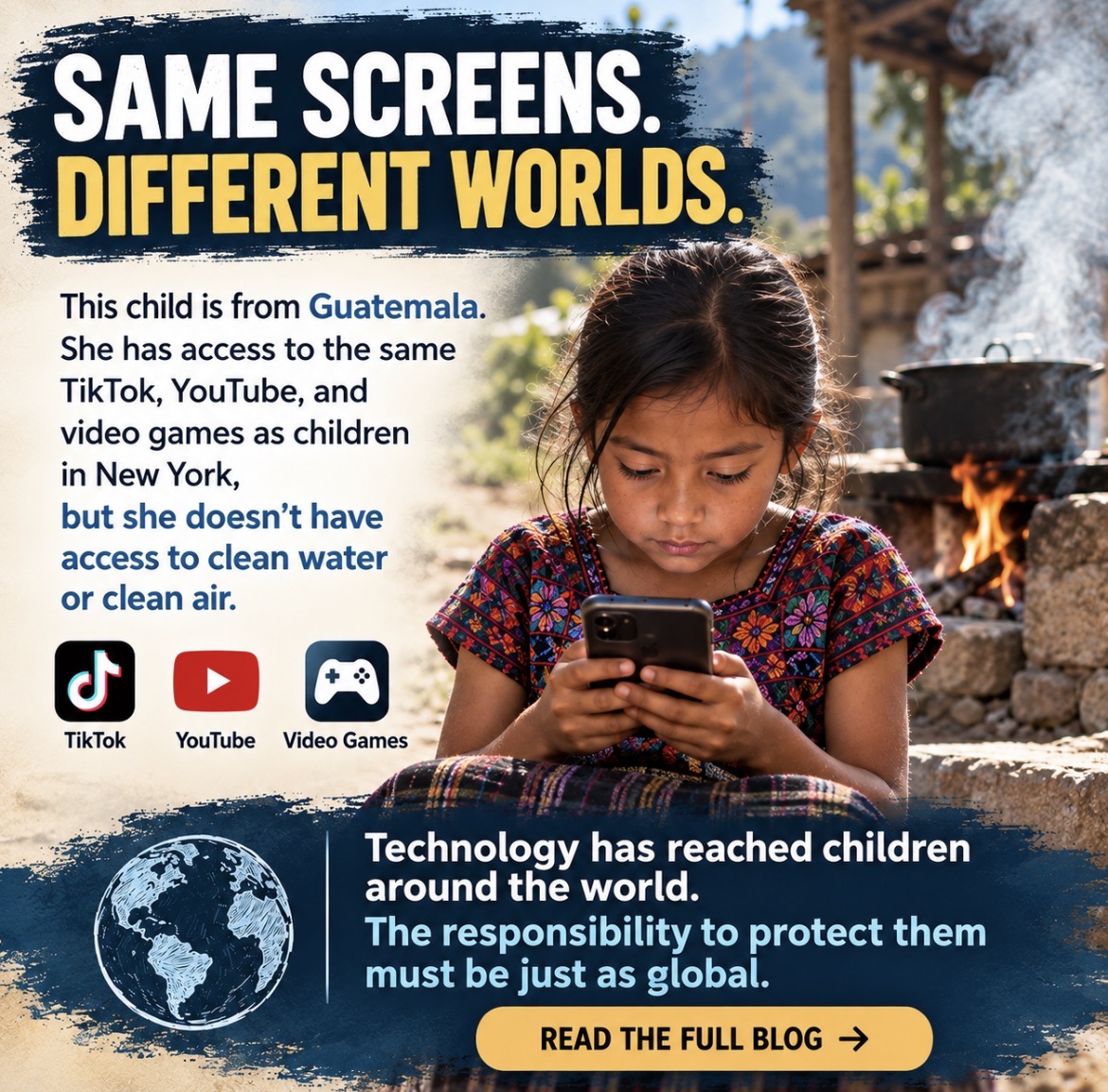
These children have access to the same TikTok, YouTube, and video games as children in New York, but they may not have access to clean water or clean air.
Technology has reached them almost instantaneously. The infrastructure needed to protect their basic health has not.
And now another public-health challenge has arrived before the previous ones have been resolved.
How Long Will It Take to Catch Up?
In wealthier countries, we have at least begun acknowledging that unrestricted access to digital media may have consequences for children’s health and development.
Yet even with considerable resources, we have struggled to translate that knowledge into effective regulation, public-health education, and protections for children.
If developed countries are still struggling to address these concerns, how long will it take for countries like Guatemala to establish similar safeguards?
Years? Decades?
Guatemalan parents aren’t behind American parents in understanding these challenges.
Parents everywhere are struggling with technology that has advanced faster than society’s ability to manage it.
But in Guatemala, that struggle exists alongside fundamental public-health problems that have persisted for generations.
And that’s what I find so troubling.
A Responsibility That Crosses Borders
José’s father and Ada’s mother reminded me of countless parents I’ve encountered at home. They recognized the problem but needed guidance and support to address it.
Parent education is essential, but it cannot be the only solution.
The companies designing these devices, games, and social media platforms must be held accountable for protecting the children who use them.
We cannot continue to place the responsibility entirely on parents while allowing companies to develop increasingly engaging technologies without adequate safeguards for children.
Age-appropriate protections, meaningful parental controls, limits on manipulative design features, and enforceable regulations should be built into these products—not left for individual families to figure out.
And this responsibility must extend beyond wealthy nations.
If we are struggling to establish these protections in the United States, imagine how long it may take for countries like Guatemala, where communities are still fighting for clean water, safe cooking environments, and basic healthcare.
Technology has reached children around the world. The responsibility to protect them must be just as global.
Parents need education and support. But the companies creating and profiting from these technologies must be required to make children’s safety a priority, regardless of where those children live.